Rocky Mountain Arsenal
Silent SpringRocky Mountain Arsenal, near Denver, became the source of a chemical contamination episode that carried industrial pollutants from a military and manufacturing site into groundwater serving nearby farms. The case makes the arsenal more than a place of production: it shows how contamination could travel underground, cross the boundary between an industrial facility and a farming district, and spread without investigators knowing how to contain it.
Site and Changing Use
In 1943, the Army Chemical Corps established the arsenal near Denver to manufacture war materials. Eight years later, its facilities were leased to a private oil company for insecticide production. The shift brought pesticide manufacturing to a site already associated with chemical production; reports of trouble had begun even before the change in operations.
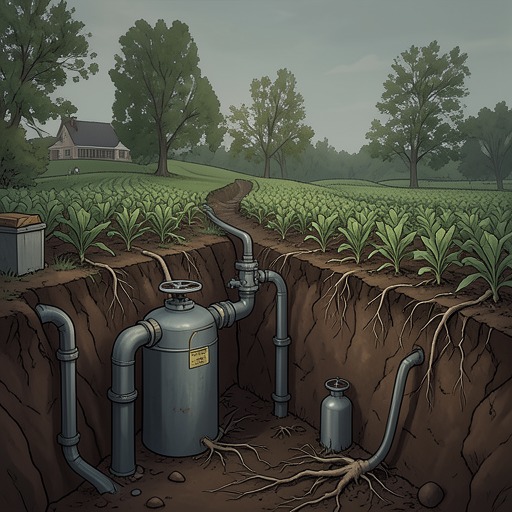
The arsenal’s location mattered because the contamination did not remain within its grounds. Chemicals moved from the plant through groundwater toward farms several miles away. The book frames that route as part of a wider danger: since surface waters are linked to groundwater, pollution beneath the land could become pollution of water more broadly.
Contamination Beyond the Arsenal
Nearby farms relied on irrigation water drawn from shallow wells. In a 1959 investigation involving several state and federal agencies, the well water was found to contain a mixture of chemicals. The contaminated water was associated with damage to crops and livestock; many crops were killed outright, and reports of human illness were thought by some observers to be related.
The account stresses the uncertainty as well as the harm. The affected area’s extent was unknown, and the seepage had continued to spread. Investigators knew of no way to contain the contamination or halt its advance. The problem was therefore not simply a past release with a clearly bounded aftermath, but a continuing movement through an underground system whose reach could not yet be defined.
The Significance of 2,4-D
Among the episode’s most concerning findings was the presence of the weed killer 2,4-D in some wells and in the arsenal’s holding ponds. Its discovery added a specific pesticide to the evidence of contamination and pointed to a connection between the facility’s chemical operations and pollution beyond the site.
The book presents Rocky Mountain Arsenal as one example of the dangers that Rachel Carson and her scientific colleagues had become alarmed about: the widespread use of persistent poisons in agricultural control programs. The arsenal case gives that concern a geographic and material route—from a manufacturing site, through groundwater, into farm wells and irrigation—while the unknown extent of the seepage leaves the consequences open-ended.